

Shaun Majumder

Jeffrey Kerr

Episode 72/March 2026
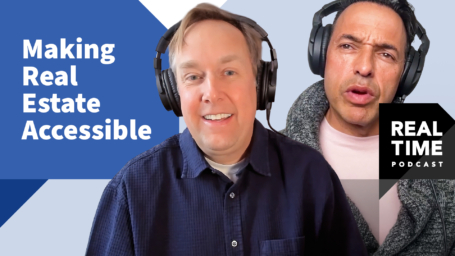
Making the Real Estate Journey More Accessible with Jeffrey Kerr
SUBSCRIBE





Whether facing mobility, visual, or auditory barriers, many clients require accommodations to make the real estate journey more accessible. This is something every REALTOR® can help with—it doesn’t have to be up to just a few who specialize in accessibility.
Jeffrey Kerr, a REALTOR® and author of Barrier Free Real Estate: Achieving Freedom at Home has spent more than 20 years advocating for more accessibility in real estate and helping clients with disabilities navigate the process. Jeffrey joins this episode of the REAL TIME podcast to look at common accessibility setbacks in real estate and how all REALTORS® can help their clients overcome these barriers.
Listen on your favourite podcast app
Episode Transcript
Jeffrey Kerr: Designing homes for everyone, regardless of age or mobility, whether you're eight or 88, that, to me, is the goal.
Shaun Majumder: Hey, guys. Today on REAL TIME, I speak with a gentleman named Jeffrey Kerr. He's a real estate agent who has been working with people with disabilities as his clients for many years, all the way back to 2004. He's got a great story to tell, and we're going to go deep on what exactly accessibility means in the world of real estate. We're going to talk about the features in homes, we're going to talk about what's working, what's not, and I think you're going to really enjoy it.
Let's dig in. Buckle down. Here we go, my conversation with real estate agent Jeffrey Kerr. Oh, this is exciting. This is exciting, ladies and gentlemen of the world, whether you're in real estate or not. We have an incredible guest today. Somebody who's going to provide some deep insight, some long historical knowledge. Of course, today, joining us on REAL TIME is the one and only Jeffrey Kerr. He is going to tell us why he is such an amazing Blue Jay fan. That is why we're here today to talk about.
We're here to talk about the Jays. Of course, I'm kidding. We're both being Jays. Let's see it, baby. Yes, Jeffrey Kerr, Blue Jay fan, which we have to touch on a little bit, but really, that's not what you do. Of course, you are a REALTOR® who has lots of experience in making real estate more accessible, the journey more accessible. Accessibility is what we're talking about today.
Something that I know, Jeffrey, I've taken for granted in my mind, when I'm thinking about real estate, and I was thinking about topics, and then when I saw your name come across, and I saw what we're going to talk about today, lights went off. I'm like, "Of course. Oh, my gosh." Thinking about all the people who need to have access. First of all, tell us a bit about your background and why you, in this discussion, and what accessibility in real estate means to you, but also to the world?
Jeffrey: Thank you, Shaun. It's great to be here. I certainly appreciate the opportunity to come on the podcast and talk about accessible real estate. It's something that I've been doing for a lot of years. I grew up in a family. My aunt had MS. My mom is an occupational therapist/physiotherapist who worked at Toronto Rehab. It was just a fact of life for me growing up in that environment. When it came to real estate, it was just a natural fit for me to work with people with disabilities and help them find a home that works for them.
For many years, I've written articles for the Canadian Paraplegic Association, which is now the Spinal Cord Injury Ontario. I've written articles for them. I've took those articles, and I've actually put them all together in a book, which I call Barrier Free Real Estate - Achieving Freedom at Home. I wrote this book basically as a resource for people who are suddenly in need of an accessible home, and they don't know where to start.
Shaun: What percentage of your clients are those with disabilities?
Jeffrey: It varies from year to year, but on average, it's probably about 65% to 70% of the buyers and sellers that I work with are people with disabilities or are looking for a home to accommodate someone.
Shaun: Right, because these are things that maybe, obviously, if you don't have disabilities, it's not top of mind, but, man, you are a very important specialist when it comes to this in terms of going through the checklist of what is needed to make a house more accessible. Why is it that accessibility in real estate matters, broadly speaking? Then I'd like to get down into some details about what exactly are those things per room that we need to think about when we're thinking about accessibility?
Jeffrey: I think it's important for everyone because everyone, regardless of their age, whether you're eight or 88, you can appreciate an accessible home. It could be a parent pushing a stroller, it could be someone looking to age in place, it could be a family member that you want to welcome into your home. Regardless of the reason, accessibility is so important in our homes for everybody. Whether you realize it or not, there are people in your life that will benefit from an accessible home and being able to enjoy your home as much as you do when they come to visit.
It could be you have an injury, you sprain your ankle, and suddenly climbing the stairs are a challenge. It could be anything. You're welcoming an older parent to come and visit, so having access to a washroom is important so that they can stay. There's an entrance solution so that you can welcome people into your home. There's just so many factors into it, and accessibility, I feel, is just important for everyone.
Shaun: When you first started thinking about this as a business model, in a way, what were the things, the barriers that you were seeing? Is the system already being conscious and doing their best to accommodate, or are you seeing that in the beginning it was really lacking, now there's a little more awareness, so it's becoming more prevalent in the discussions, or are you saying it's right where it needs to be right now? Where would you say, on the scale, the overall buying and selling experience is like for people who need accessibility?
Jeffrey: To circle back, I've been a REALTOR® since 1999, so for quite a few years. Back when I started focusing on accessibility around 2004, there was one other real estate agent in Ontario that was focusing on working with people with disabilities. There really was no model to follow there. There really wasn't a lot of information out there to help find homes that are accessible or could be made accessible. Slowly, over the years, that's improving.
What I found early on, it was a question of understanding what people's needs are and then going through the listings and identifying homes that could meet those needs. Fast forward to today, the real estate boards are getting a little better in gathering information on the homes and the accessibility features within those homes. It's a little easier to find properties, but it's still, in my opinion, it's not where it needs to be.
Shaun: What was it that inspired you to say, "Oh, these are the people that are not being looked at. We need to take care of that. In my newfound, I got my license. Here we go. I know I can specialize." Was there one specific incident that made you say, "Oh, this is what I want to do and focus on," or was that the reason you got into real estate to begin with? Tell me about that story, about what made you say, "Oh, this has got to be for me."
Jeffrey: I think the aha moment was in 2004 when my aunt needed to sell a pre-construction condo that she purchased in the mid-'90s. It was supposed to be wheelchair accessible. My aunt and uncle went into the sales office, bought what they were told was a wheelchair accessible condo. Through construction delays, my uncle had passed on before that condo was ready for occupancy. I was with Aunt Jean when she rolled through the front door, and she knew very quickly that she couldn't live there independently.
She handed me the keys and said, "Jeff, I need you to sell this condo for me." The condo had a really good bathroom, large bathroom with a roll-in shower, but the kitchen itself was a joke. It was so poorly designed, there was no way that she could live there independently and look after meals. I actually started researching selling accessible condominiums and there was no resources out there.
I met with, gentleman who name is Kevin Rogers at, at the time, it was called the Canadian Paraplegic Association. I was asking him what his advice was to market this condominium. He provided some advice for me. We had a great chat. At the end of the chat, he said, "Jeff, our community really needs someone with your background and your willingness to learn to help find accessible homes." That was the moment where things became clear in my mind that this is something that is a natural fit for me. Again, it was a good business opportunity as well. It was a perfect fit.
Shaun: That's amazing. I love that. Did you feel like, "Oh, this is almost a newfound purpose?" It sounds like to do what you did when you jumped in, the things that motivated you to get there, it wasn't as simple as, "I'm going to get my real estate license, and I'm just going to--" You were motivated by a passion and a vision for what was missing.
Jeffrey: Yes. Going even further back, I was building houses before I got my real estate license. I got my license to help sell the homes that I was building. That in itself gave me a really good understanding of homes, how they're built, and how to identify homes that could be modified for accessibility. Then accompany that with the accessibility side of things. Again, it was just a really good fit. It's also very rewarding. I get an opportunity to work with some fantastic people who have challenges that they need solutions for. I'm able to help them find solutions. Again, it's a very rewarding part of my business.
Shaun: I think we take for granted some of these challenges. Take me through some of those things, but first, actually, I want to ask you, what are some of the shortfalls that you've noticed making it harder for those with mobility issues or those with visual or auditory limitations when it comes to searching for a home?
Jeffrey: The information that's shared out there is not immediately evident as to what the accessibility features are or how these homes can be modified. It starts with disseminating information and finding properties that can work, are already accessible, or can be modified to meet my client's challenges. It always starts with a conversation with a person as to what are their needs. There's the traditional real estate questions, location, budget, but when it comes to barrier-free accessible real estate, then it's a question of what are the individual's specific needs that need to be accommodated within their home, and then helping them find that perfect fit.
Shaun: It's not one size fits all?
Jeffrey: It definitely is not one size fits all. Every individual is unique, and the solutions that work for them have to be unique and tailored to them as well.
Shaun: You had mentioned earlier that it's not clear when you're doing a search which houses are accessible or have accessibility features. If I'm just a person who is looking for a home and I want to do a broad search, I don't even have an agent yet, I would love to be able to go and see what houses do have accessibility features and which ones don't.
Jeffrey: Buyers love searching on REALTOR.ca. People are addicted to it.
Shaun: Love it.
Jeffrey: It's great. They do their research, and then they reach out and say, "Hey, I want to look at this house. If that resource was able to provide additional information about accessibility features, then that would be a definite bonus.
Shaun: Let's talk about some of those features. For example, can we go through what some of these features might be? In the dream world, where we can say, "This is what's going to be in the listing," what are some of those features that most of your clients are looking for?
Jeffrey: The two main features are definitely an entrance solution and a bathroom solution. You've got to be able to get in and out of the home or condominium safely, and the bathroom is necessary, obviously, to be able to stay. Those are probably the two primary features that buyers would be looking for. How do I get in and out of the home? What does the bathroom look like?
Shaun: I think if I were just to take that for granted, stairs are obviously not for everybody. The solution would be, would you look for a home that would have the ability to create a ramp, or it comes with a ramp? Am I right in assuming that that would be a solution to stairs?
Jeffrey: Yes. The entrance solution can take many different possibilities, a ramp, a landscape ramp, a wood ramp, a metal ramp, or it could even be a platform lift on the outside of a house. It depends on the height difference from the outside grade to the front door threshold. What's that height? Can it be reached by a ramp, or would a ramp be too steep? We've got to look at doing a platform lift.
Shaun: Talk to me about the bathroom.
Jeffrey: We always have to talk about the bathroom. Generally, when I'm talking with a buyer for the first time, the conversation quickly goes to the bathroom, because it's, what are their specific needs within a bathroom? Is it a zero-threshold roll-in shower? Is it a bathtub where they could work with a bath bench and then transfer into the bathtub? It is one of the first conversations, and it's one of the more important ones.
Shaun: It's very important. Getting on and off the toilet, entering the bathroom, the shower space is really important, the bathtub space is really important. When you're looking for a house, how much of it are you looking for that is already built in versus the ability to modify?
Jeffrey: The majority of the clients that I work with, we look for a house that can be modified for their needs, and there's a couple reasons for that. Finding an accessible home that's ready to go and available is pretty rare, and a lot of those homes were modified for a specific individual. Once they have a home that meets their needs, they stay for as long as they can in that property. They don't come up for sale very often.
If they do, is there a buyer out there who can make use of the accessibility features in that home? If it was modified for a specific individual, or was it modified more for universal design, which can accommodate anybody regardless of age or mobility? To go back to your question, the majority of my buyers end up buying a house or a condo that they can modify for their needs so they can make it exactly what they need it to be.
Shaun: What about kitchen?
Jeffrey: For the most part, I found people can make do with traditional kitchens as long as there's room enough to maneuver a wheelchair, particularly if you're cooking in a seated position. If an individual is living by themselves, then maybe they need to be looking at a modified kitchen. Kitchens can vary quite a bit. There's a lot of modifications you can make in a kitchen to make it accessible, like a roll-under sink, lower countertops, ovens, or a cooktop that have the controls on the front so that individuals don't have to reach over a hot element in order to change the temperature. There's a lot of safety features that have to be considered.
Shaun: Then I also heard there's a way to sometimes-- Some of it is pretty inventive and creative. I heard about you can push a button and things lower to you. You can get these built into your home?
Jeffrey: Yes. There's a company that will modify your kitchen cabinets so that the inside of the cabinets actually will lower down to the counter height. Then you can place your items on the shelves, and then hit a button or click a remote, and then the shelves rise back up. There's also shelving that was on a handle so that you can pull them down to a lower level. There's a lot of technology and innovation out there to make the kitchen accessible.
Shaun: Then as I'm walking through the home, I guess there's the entrance issue with stairs that can be resolved. What about within a home, going up and down the stairs if there are stairs or multi-leveled homes?
Jeffrey: A lot of homes are too small. The footprint is too small to add a mechanical lift between two floors. A big part of looking for an accessible home is finding a space that could accommodate an elevator. An elevator being an elevator in an enclosed shaft that goes between three or more floors. There's also a product called a telecab, which is essentially like a London telephone booth that goes between two floors. That gets mounted on a load-bearing wall, runs on a track, and that's sometimes a little easier to fit into a home.
Two-story homes, I think, are good in that they often have a lot more square footage. With the cost of real estate, the majority of the cost of a home is land value. It's not always possible to find a large ranch bungalow that's all in one level. A lot of people have to consider a two-story home and then find a solution to get up to the second floor.
Shaun: What about when we think about people with auditory or visibility challenges, what are some of those features that are considered in the buying and selling of homes?
Jeffrey: In condominiums now, for those who are hard of hearing or deaf, you'll notice with the smoke detectors now, they have strobe lights. It's not just a siren or an alarm that goes off. It's actually a strobe light that is very, very powerful. There's also, for lack of a better word, like a thumper that you can put in your bed so that if the smoke alarm or the CO detector goes off in the night, it actually wakes you up-
Shaun: Wow.
Jeffrey: -in your bed. There's definitely technology out there that can help in the home-buying, home-selling process.
Shaun: I love that. Now, with the advancement of technology in terms of lighting and switches and air conditioning, heat, HVAC, what are some of those advances that you're seeing that are not only convenient for people with accessibility needs, but just generally speaking?
Jeffrey: The whole home can be automated from opening doors to turning on lights to turning on motion sensor faucets. Pretty much everything in a home can be automated so that if someone's not able to physically do the tasks themselves, they can use something like Google Home and just say, "Hey, Google, turn on the light," or "Hey, Google, open the door." There's so many options right now in home automation, and it really provides a lot of flexibility and freedom for people to live independently at home.
Shaun: Yes. Jeff, I know that there are some organizations, there are some places in Canada that are starting on the good foot there. They're leading the charge. I'm actually here in Nova Scotia now where I've recently repatriated to, and as it turns out, the Nova Scotia Association of REALTORS® are really working hard to include more of those details in listings, really trying to shine a light on those features that are needed in the accessibility space.
Jeffrey: Absolutely. I think it's a great pilot project. I can speak to what's happening in Ontario. Over the last few years, there's more and more data that's being collected for homes and the accessibility features. I think it's so important to have that data and make it available. It's not just in Nova Scotia and Ontario, but all across Canada, this needs to be done so that everybody across the country has as easy access to the data and searching for homes.
I can't stress the importance of having floor plans for people to understand the flow of the home and being able to look at options for increasing a bathroom size. I think floor plans are crucial. They're definitely a valuable tool in the listing, along with all of the room data and the features data.
Shaun: Right. Now, is there something to be said about the definition of what makes something an accessibility feature? If I'm selling and I want to brand it as, "This is an accessible home," because we said it's not the same for everyone, is there some kind of criteria that makes something specifically thumbs up, it gives us the accessibility approval?
Jeffrey: The short answer is no. I think it's somewhat subjective to the individual who's inputting the listing as to what features, if they consider them accessible. Now, some of the criteria in terms of door widths, is there a roll-in shower? Is there an elevator? Those features are very specific. I find that there's a lot of listings out there that say they're accessible, but when you drill down, they're just talking about being accessible to the bus stop or accessible to the grocery store. It doesn't always line up with accessible from a mobility accessibility point of view. Accessible doesn't really have, I guess, a set definition when it comes to listing.
Shaun: I think of even your Aunt Jean, was it? Jean, she thought it was going to be, and then she gets in and is like, "No, this is not going to work."
Jeffrey: Yes, exactly. Had she had some more information about the kitchen layout, then yes, she probably would have known it more in advance that that wasn't going to work for her. That's a great example. You've got to have more information.
Shaun: Now, that was in 2004, and you have been working with clients for so many years. I'm sure a lot of agents who are watching this, REALTORS® watching this now, are like, "Yes, I want to be more involved and work with those clients more." What is a respectful way to approach accessibility in real estate with clients?
Jeffrey: I think it starts with a conversation. Every client is going to have a unique set of needs. It's just a question of talking to them, asking them what an accessible home means to them, and what are their needs, and just helping to understand how language is so important. How would you like me to speak to you? I always default to person-first language. People with disabilities, you're a person with a disability.
I have a client who said, "No, Jeff, I'm a disabled person. That's how I want to be referred to." That's their choice, but that's just a conversation that we had so that I can speak to them in a way that they're comfortable with. I don't think people need to be intimidated by it. Just simply ask the individual the questions. There's a saying that I love. It's nothing about me without me.
Shaun: Oh, I love that.
Jeffrey: Nothing about me without me. Don't make decisions on behalf of a person without asking them first. I think that's just so important. People love to be heard and listened to. People will always be happy to tell you their story. You'll learn information, and you'll learn how to speak to them effectively and respectfully, and then just take it from there.
Shaun: I think it's just like any personal one-on-one relationship. When you're developing a relationship, a bond, a shorthand, this relationship is going to last for a while because you really want to get to know, whether they are a person with disabilities or not, you always want to know what are their needs, what are their wants. In this case, it sounds like you don't need to tiptoe around anything. Just having a direct conversation asking, how do you like to be referred? How do you see yourself? What can I do to accommodate that? I think that just is, it's almost common sense, but maybe in the world we live in where people, they're not sure. I think it's good hearing that from you.
Jeffrey: It's not a quick and easy transaction. There's always some extra layers. There's always extra time. Working with people with disabilities is not for a person who likes to do a quick sale, a quick buy. That's not going to happen. It takes time to understand the client and to find them the right home. There's a lot of extra layers in terms of bringing in accessibility consultants to make sure that the home can be modified properly. There's a lot of extra considerations. That's why you need to be willing to spend that extra time with a client to make sure that It's done properly.
Shaun: I love that. When I think about some of these features and these elements, some of them, they actually sound beneficial to able-bodied and persons with disabilities. Talk to me about universal design. Talk to me about, are there-- We know it's not one size fits all, but clients are obviously thinking about resale value as well. A young person coming up, they know they need certain features in the house, but then they know that what if they want to move on? What if they get a job somewhere else in a different city? They want to sell their house. How are people with disabilities thinking about the resale value, or are they? Are most people, when they find their house, they stay? Talk to me a bit about that.
Jeffrey: I think for the most part, if someone buys a home and has it modified for their needs, they'll stay there for as long as they can. There's certain modifications that can be made that are very-- They make the home more saleable. For instance, a zero-threshold shower. I also call it a roll-in shower. That's probably one of the features that is most in demand with the clients that I work with. That feature, an elegant roll-in shower, is beneficial for everyone regardless of age or mobility. A lot of homes now are being built with these elegant zero-threshold showers. It's just a nice feature to have, and that definitely adds to the resale value.
On the other side of the coin is features that may be right for the individual, but not necessarily great on the resale value. I actually find, as an example, would be a walk-in tub. Those are fantastic for individuals who need them or like to use them. They're great tools. I always tell my clients, if that's something that you want, and that helps you live independently and comfortably in your home, then absolutely put one in, but when it comes to resale, don't expect to get your money back out of it because finding the buyer who wants that feature is pretty rare.
Shaun: Because people love bathtubs, people love taking baths, are there ults to that?
Jeffrey: There's not a lot of options when it comes to bathtubs. I agree with you. There's a lot of people who are bathtub people. They absolutely want a bathtub. If that's what's necessary, then go for it. There's also a chair that you can put in the bathtub that will then lower you into the tub. That's an option too. Again, it comes down to the individual and what works for them.
Another example are chair glides where you have a staircase where you have a mechanical chair that glides up the stairs. They're very helpful for people who are able to walk but maybe not navigate stairs, but when it comes to the resale value, I find that people aren't willing to pay a premium for a chair glide. They're more of a temporary fix for the individual. Again, a walk-in tub, it's difficult to get the money back out of those when it comes to resale.
Shaun: What are the other considerations? When you're talking to real estate agents who are out there, what are some other things to consider when you're engaging with clients?
Jeffrey: The accessibility consultants, we touched upon it earlier. I think it's really important that when an individual is looking at a home that you bring in the experts to confirm that the specific modifications can be done. Again, what the cost is. It's one thing to be able to do the renovation, but what's it going to cost? Then there's the safety component of it. Is there a second means of getting out of the home in an emergency?
A lot of people are concerned with high-rise buildings. They want to be on the ground floor of a condominium because they want to be able to get out in an emergency. The solution for that is called an evacuation chair. These are fold-up portable chairs that you can have either in the stairwell or in your unit that in a case of an emergency, you can transfer into the chair, and then someone can push you down the stairs because they have tracks on them that are designed to be pushed down a staircase.
Shaun: Wow.
Jeffrey: That's a solution for people who are concerned about living in a high-rise. Fire department ladders will only go up to the seventh floor, and that's only if the fire truck can get right beside the building. When you look at most downtown cores, there's buildings popping up everywhere, and they're multi-story. How do you get out in an emergency? In a evacuation chair.
Shaun: This has been such an important conversation. I think REALTORS® and real estate agents, they need to get caught up on all of this information. I think it's important to be able to connect with many people of all kinds. In closing, what are your things that, number one, you feel like the system needs to really catch up on, whether it be in the listings or what have you? What are other ways? Are there builders that need to consider more things? What would you do if you could be in control of everything? What would you change? What do you think is working? What do you think, Jeff?
Jeffrey: I think there's a lot of things that are working and that just needs to be improved on in terms of getting that data, getting that information out there to the public and helping everybody find homes that are accessible because when an accessible home comes on the market, it's really important to find the right buyer for that home, a buyer who appreciates all the accessibility features. That's certainly one thing.
Builders. There's a builder in Toronto, the Daniels Group, that is ahead of the curve in terms of offering pre-construction condos that are fully accessible. There's another group that's called the Accelerating Accessibility Coalition, which is a group of builders and professionals that are involved in the building industry. This group has got together to advocate accessibility and to promote accessibility.
These are all things that are happening that are very positive and important. I certainly want to see these initiatives to continue. Again, it's just having a conversation and just willingness to learn. That's how I got started way, way back. I just had a willingness to learn. You talk to the right people and you talk to your clients and just be open-minded.
Shaun: It's amazing because from what I understand, if I'm thinking about people who may come as clients, they're all going to be from all kinds of backgrounds and even with different disabilities. Talk to me a bit about that, some of the people that you've worked with.
Jeffrey: Aging in place is very popular now. There are people wanting to stay in the homes and in the communities that they're comfortable in. Can their homes be modified over time to accommodate their deteriorating mobility? That's something to consider as well. Again, going back to designing homes for everyone, regardless of age or mobility, whether you're eight or 88, being able to live independently in that home for as long as you want, that, to me, is the goal.
Shaun: Thank you so much for doing what you do. This has been an incredibly insightful conversation.
Jeffrey: Thank you very much. I really enjoyed it and I appreciate you bringing me on the pod.
Shaun: You got it. See you, Jeff. Go Jays go. Thanks so much, Jeffrey. What a great conversation, shining a light on accessibility issues in real estate. I learned a lot. I hope you guys did too. Of course, if you liked today's episode, be sure to like and subscribe wherever you digest your favorite podcast. Of course, today's episode is brought to you by the Canadian Real Estate Association (CREA), production brought to you by Alphabet® Creative. My name is Shaun Majumder. Thanks for joining us on REAL TIME. We'll see you next time on REAL TIME. What a time. What a time.