
A Look into Canada’s Housing Market: Spring 2026
Read a summary of recent CREA data analysis.

The Canadian Real Estate Association (CREA) statistics team releases a monthly data about home sales in Canada, as well as quarterly forecast.
This month, both reports were produced.
Here’s a summary of what you need to know about the state of the housing market activity in Canada right now.
Canadian Home Sales Activity Little Changed in March
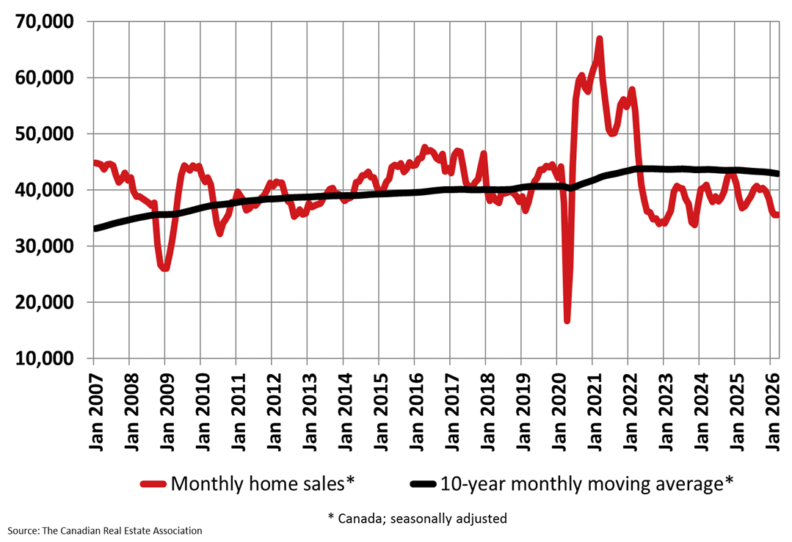
The number of home sales recorded over Canadian MLS® Systems was virtually unchanged (-0.1%) on a month-over-month basis in March 2026.
“Home sales activity remained at lower levels in March, as rising global economic uncertainty, along with a mid-month jump in fixed mortgage rates tied to incoming higher inflation, piled on to an already shaky economic start to the year,” said Shaun Cathcart, CREA’s Senior Economist. “2026 is still expected to see a modest amount of upward momentum in sales and a stabilization in prices as some pent-up first-time buyer demand enters the market, but the forecast for the year has had to be revised downward. The timing of higher mortgage rates, along with the perception they may be temporary, could keep would-be buyers away at the most active time of year – April, May, and June – as they wait for rates to come back down.”
March Highlights
- National home sales were almost unchanged (-0.1%) month-over-month.
- Actual (not seasonally adjusted) monthly activity came in 2.3% below March 2025.
- The number of newly listed properties edged down 0.2% on a month-over-month basis.
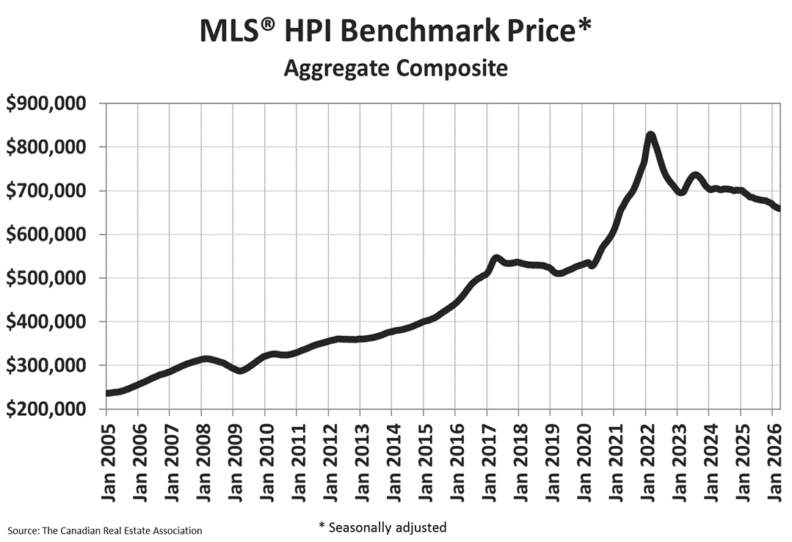
- The MLS® Home Price Index (HPI) fell 0.4% month-over-month and was down 4.7% on a year-over-year basis.
- The actual (not seasonally adjusted) national average sale price was down 0.8% on a year-over-year basis in March 2026.
Read the full analysis on CREA Stats.
CREA Downgrades Resale Housing Market Forecast
The major factor underpinning CREA’s long-standing forecast for higher activity going forward is the idea that pent-up demand, particularly from first-time home buyers, would start to emerge from the sidelines after having been shut out of the market over the past four years. An important milestone for that process is the expectation that interest rates will no longer fall, and that home prices in affected parts of the country have stopped declining.
That said, beginning in the second half of March, inflation from the spike in oil prices raised the odds of a Bank of Canada rate hike later this year, raising bond yields and resulting in a jump in fixed-rate mortgages. Higher mortgage rates are expected to curtail activity on their own, but the idea that the oil shock may be short lived will likely also cause many buyers to wait for rates to come back down, further dampening activity at the most active time of the year for housing markets.
Along with a generally tepid start to the year for Canada’s economy and weaker than expected housing activity in the first three months of 2026 has resulted in a downgrade to CREA’s forecast.
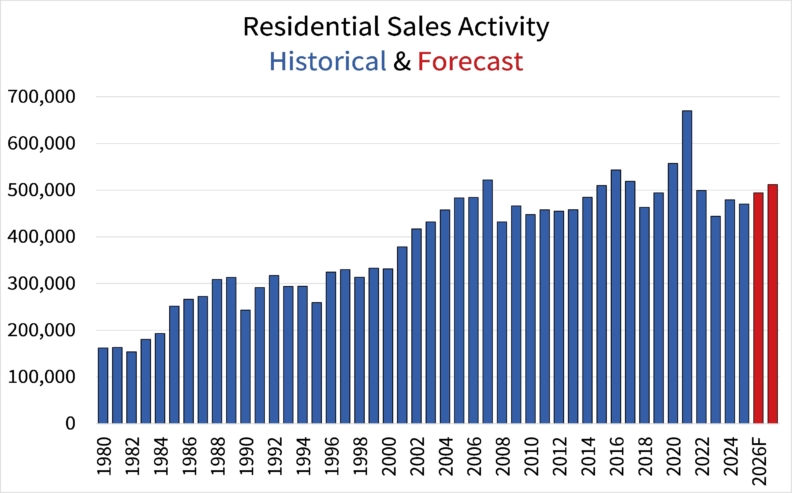
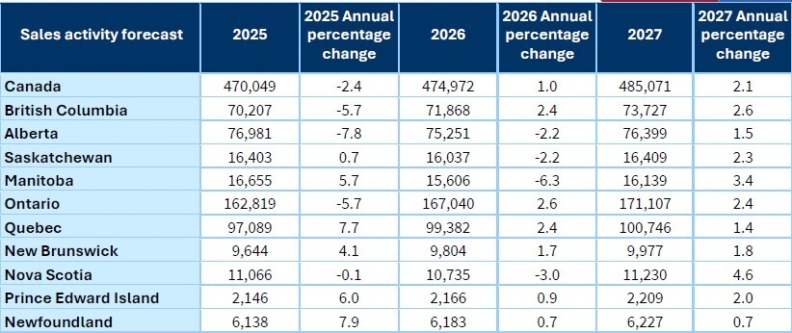
Some 474,972 residential properties are forecast to trade hands via Canadian MLS® Systems in 2026, representing an increase of 1% from 2025. As previously forecast, the national gain is still expected to be driven largely by British Columbia and Ontario where sales have more room to recover. Activity is forecast to rise only modestly or decline in other provinces where activity had previously been elevated due in part to record population growth which is no longer a factor.
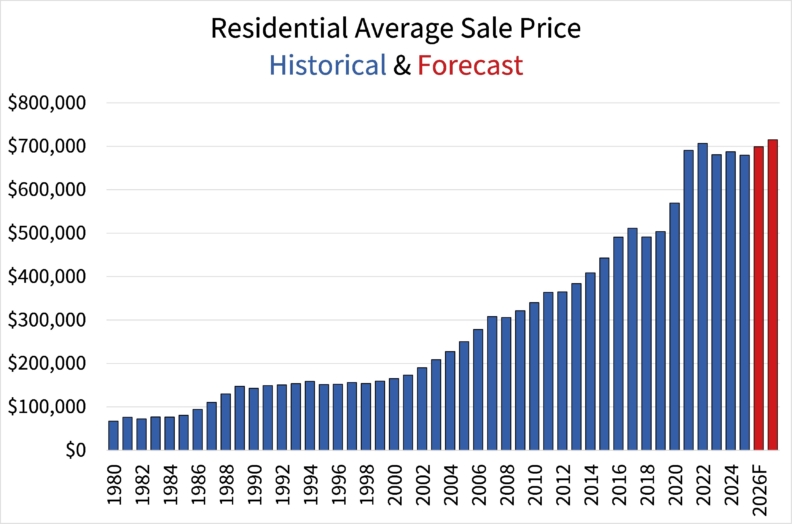
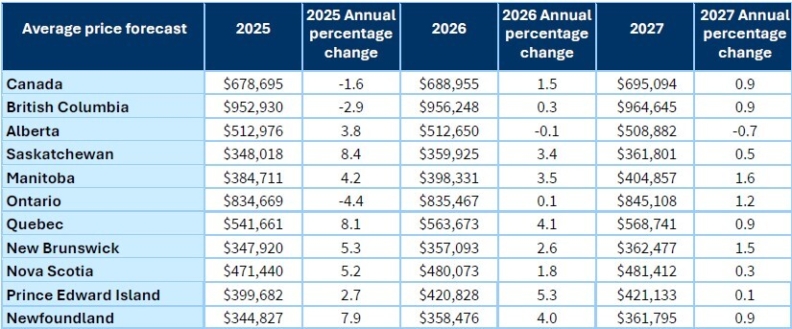
The national average home price is forecast to rise 1.5% on an annual basis to $688,955 in 2026, with virtually no growth in B.C., Alberta, and Ontario, and gains fading into the 2% to 5% range in other provinces.
In 2027, national home sales are forecast to climb a further 2.1% to 485,071 units. That said, this number could be revised above the 500,000 should higher interest rates prove unnecessary to fight inflation.
The national average home price is forecast to edge up by 0.9% from 2026 to $695,094 in 2027, with gains held to below inflation across the board. As with sales activity, this number may be subject to an upward revision should the current oil shock and associated inflation prove short lived.
This forecast would mark years six and seven that the national average home price has hovered close to the $700,000 mark.
For more information, including data specific to your area, visit CREA Stats. New data is available monthly to help REALTORS® keep current and serve their clients better.