
Guide to Hydronic Heating for REALTORS®: What Clients Should Know

If you're showing a home with a boiler and radiators, don't apologize for it. You might be sitting on the best heating system in the neighbourhood. Hydronic heating (that is, systems that use hot water rather than forced air to heat a home) is widely misunderstood by those who've never lived with one.
As a Red Seal plumber and hydronics specialist with more than 26 years in the trade, and owner of Triton Home Service in London, Ontario, here's what I think every REALTOR® should know before walking into a showing.
It's more efficient than forced air, by a wide margin
Water carries heat far more efficiently than air. A high-efficiency condensing boiler operates between 85% to 95% efficiency; and because heat delivers directly to the room, there's almost no distribution loss.
Forced air systems, even high-efficiency ones, routinely lose 15% to 30% of their heat through ductwork before it ever reaches the living space. That's heat the homeowner is paying for, but nobody is feeling.
Modern condensing boilers also modulate their output in a way most furnaces can't match. A 100,000 BTU (British thermal unit) furnace runs at either full capacity or half, just two speeds. A modern condensing boiler can run at 10% of its capacity and maintain a comfortable temperature all day.
Less cycling means less wear, lower gas bills, and longer equipment life.
The comfort is different, in a good way
Forced air heats a room by blowing warm air through vents. Hot air rises, so any room with high ceilings (think great rooms and cathedral ceilings) will find the warmest air sitting up near the top of the room, not where the people are. A hydronic system delivers heat at floor level or through radiators, right where occupants can feel it.
Furthermore, if you do so much as open a door in winter, the warm air from a forced air system will rush out immediately. In a hydronic system, the heat is held in the water mass inside the radiators or the slab, helping the room recover faster because the heat source is still physically present in the room.
Lifespan and maintenance
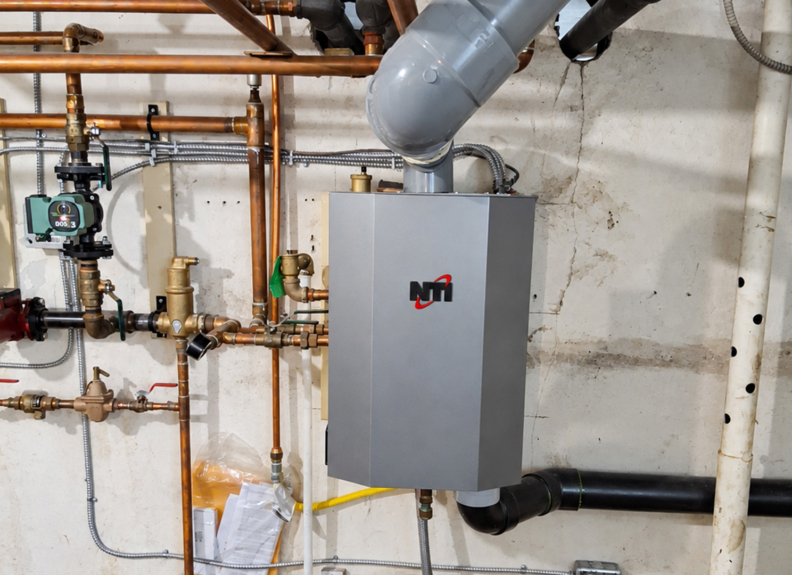
A properly installed boiler regularly outlasts a furnace, sometimes by decades. Because a condensing boiler runs at low capacity most of the time rather than cycling hard on and off, the wear on components is significantly lower.
I serviced a boiler recently in London, Ontario, that had been heating the home and its domestic hot water since 2008. Never serviced, never touched, and still running. I don't recommend skipping maintenance, but that story tells you something about the durability of a well-installed system.
One boiler, endless possibilities
This is what clients rarely understand and REALTORS® may forget to mention: a home with a boiler already has the infrastructure for a long list of upgrades.
That same system can be expanded to heat a swimming pool, power in-floor radiant heat, add a towel warmer to a bathroom, melt snow on a driveway or outdoor path, and/or supply domestic hot water through an indirect water heater (which is more efficient and longer-lasting than a conventional tank).
It always makes me a little sad when I walk into a basement and see a boiler, a separate pool heater, and a separate water heater all running side by side. One properly designed system could have done all of it, and modern controls make this easier than ever. Today's systems are managed through apps and programmable timings that deliver additional cost savings without any extra effort from the homeowner.
For buyers wondering about cooling, options do exist alongside hydronic systems. A qualified heating and cooling professional would be able to guide you about what's possible for a specific home.
What to tell your client
If your client is hesitating because the home has an "old boiler system," consider reframing it.
They may not be looking at a liability; they may be looking at a premium heating infrastructure that can be more efficient, more comfortable, longer lasting, and more expandable than a forced air system. A boiler should not, on its own, be a reason to walk away from a property.
When in doubt, call a hydronics specialist for a second opinion about a specific home.
This article is provided for general information only and is not a substitute for a property-specific inspection or advice from a qualified heating professional.