Putting Down Roots: How REALTORS® Can Support Greener, More Livable Communities
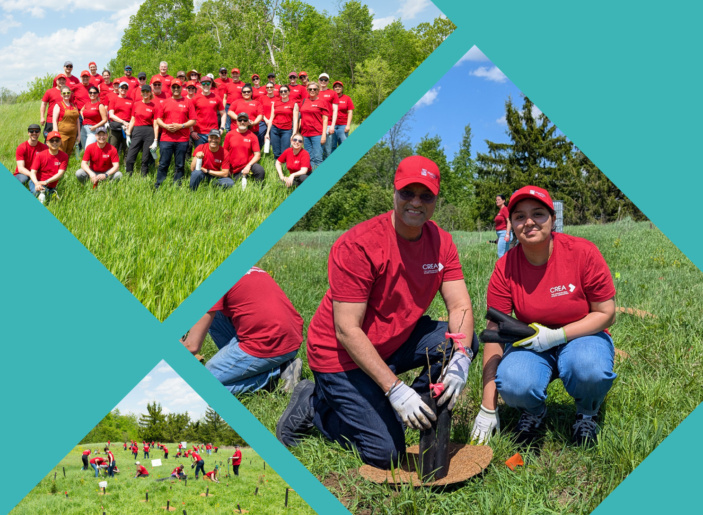
Earlier this spring, all board members and 25 staff members from the Canadian Real Estate Association (CREA) came together in Ottawa, Ontario, for a hands-on tree planting event as part of CREA’s Powered by Purpose staff volunteerism program.
Delivered in partnership with Forêt Capitale Forest, the event supported the reforestation of a former golf course in Findlay Creek that's being restored into a naturalized green space. Over time, the site will add biodiversity, habitat and more accessible green space while also serving as an acoustic buffer between the airport and nearby residential communities.
Volunteers spent the day planting more than 160 trees with guidance from local experts, contributing to a long-term restoration project.
Through the volunteers’ experience, they learned first-hand how REALTORS® and other community leaders can support similar greening efforts in the communities they serve.
Read on to learn more about the knowledge they dug up, and why tree planting initiatives are important and relevant to building better communities and homes.
Jump Ahead
Why choose tree planting?
Tree planting is a practical example of how our CREA volunteers could support building livable communities, going beyond just four walls and a roof, and helping to build homes.
These initiatives help highlight the connection between the built environment and the natural spaces around it, reminding us that strong communities are shaped not only by housing, but by the quality, comfort and resilience of the surrounding neighbourhood.
For Garry Bhaura, Chair of CREA’s Board of Directors, the event reflected a personal passion for tree planting and giving back to the community. “We aren’t just planting trees here. We're planting a hope for our future generations,” he said. “To me, it’s for the future. It’s for Mother Earth. It’s for our social purpose because CREA opens doors for thriving futures for all, and that’s what we’re doing here. We’re connecting with nature, giving back to the earth, and giving back to the communities we serve.” Bhaura has previously participated in and led other tree planting events and is an advocate for others to do the same.
REALTORS® play an important role in communities across Canada helping people to not only find a house, but a home where they can live, grow and connect.
The quality of a neighbourhood extends beyond the home itself. Access to shade, green space, parks, natural buffers and comfortable outdoor areas all help shape how people experience their home.
Supporting local tree planting and stewardship projects is just one way REALTORS® can contribute to more livable, resilient and thriving communities.
To me, it’s for the future. It’s for Mother Earth. It’s for our social purpose because CREA opens doors for thriving futures for all, and that’s what we’re doing here, we’re connecting with nature, giving back to the earth, and giving back to the communities we serve.”
Garry Bhaura, Chair, CREA Board of Directors
Finding the right home for the right tree
One of the most important lessons from the event is that successful tree planting is not just about putting trees in the ground. Just as you wouldn’t guide a client to a house that doesn’t suit their lifestyle, needs or goals, it’s important to find the tree the right home.
When selecting a tree, it’s about choosing a species that has a good chance of thriving where it is planted. Before you plant, consider:
- The conditions. Is the site sunny or shaded? Wet or dry? Open or sheltered? These details are important to take into consideration to help ensure that the trees survive and grow.
- What the native tree species are. Choosing native species that make sense for the exact area you’re planting in is important because they are already a part of the surrounding ecosystem, meaning that they will help (and not harm) the local birds, insects, pollinators and wildlife. They are also most often best suited to the local conditions making them more likely to thrive.
“We focus on planting native trees because they have grown with our native pollinators for the longest period of time,” explained Jodi Newman, Afforestation Program Manager at Forêt Capitale Forest. “They've actually developed parts of their system that are specifically adapted to the shape of the pollinators.”
For our project, Forêt Capitale Forest made sure we were planting a variety of species that fit the requirements of the area, including silver maple, bitternut hickory, gray dogwood, and white spruce.
Choosing the right tree for the site helps improve its chances of survival and ensure the planting contributes to the surrounding environment over time. If in doubt, look for organizations nearby or other resources specific to your area to help you make the most impactful.


Don’t plant and run!
Planning beyond planting day is an important part of a successful tree planting initiative or event. Long-term or continued monitoring and maintenance help ensure trees survive and provide benefits for years to come, especially during dry conditions.
“For the survival of a tree, the most important thing after you plant it is to water it and keep doing that, …ideally for the first two weeks,” said Newman.
After that, care becomes more about giving the tree room to establish.
“After the tree has … established itself, you mainly just want to make sure that the weeds around the tree aren't going to grow taller than the tree itself, … weed around a perimeter and keep it moist during dry spells,” she said.
For this event, Forêt Capitale Forest provided the site, trees, planting guidance and follow-up maintenance, helping ensure the work would continue beyond planting day.
Tips to plan an event that grows roots
For members of the REALTOR® community interested in planning something similar, a few practical considerations can help guide the process:
- Choose a project with clear community benefit: Look for opportunities that improve shared spaces, add shade, restore habitat, expand tree canopy or make neighbourhoods more comfortable for people to gather, spend time outdoors and connect with nature.
- Focus on quality over quantity: A successful event does not need to be large. Planting the right trees in the right place, with a clear plan for care, can create more lasting impact than planting more trees without the conditions they need to thrive.
- Make participation meaningful: Help volunteers understand why the project matters, what they are contributing to and how the trees will benefit the surrounding community over time.
- Plan beyond planting day: Decide on and confirm how the trees will be watered, weeded and monitored after the event, especially during the first few weeks and during dry or drought conditions.
Growing trees, growing impact
The trees planted at Findlay Creek will take time to establish and grow, but their impact will continue well beyond the event itself. As the site matures, it will become part of the surrounding landscape, providing habitat, greenery and a natural buffer for the nearby community.
For Bhaura, the event also showed how tree planting can create a personal connection. “It’s not just tree planting for me. It’s actually making memories.”
For many of the participants, it’s a reminder that local action can leave a lasting mark, not only on the landscape, but on the people and communities who help it grow.
With the seed planted, check out these resources
For more guidance on planning a tree planting project, explore resources like Tree Canada and Green Municipal Fund. These organizations have information that can help you in choosing appropriate species, preparing the site and caring for trees after planting.