
What the Data Says About the Canadian Housing Market, Canadian Economy
The current snapshot.

Jump Ahead
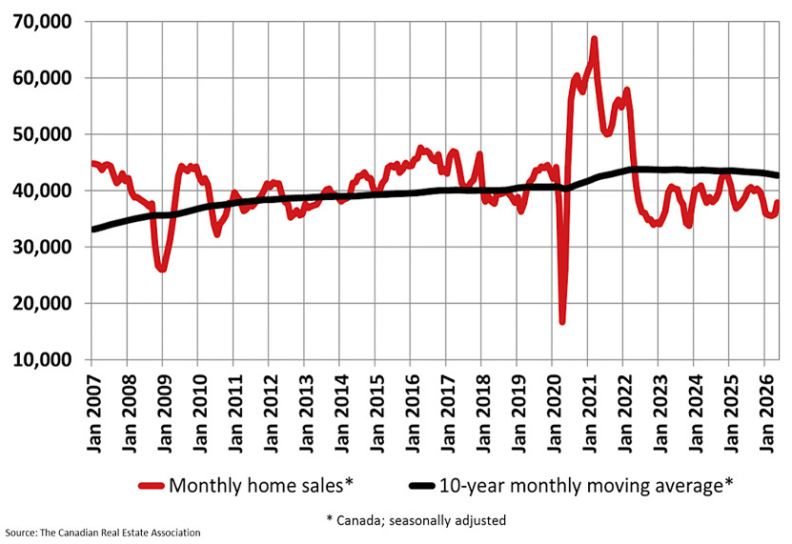
The number of home sales recorded over Canadian MLS® Systems increased 5.5% on a month-over-month basis in May 2026.
“The national sales increase from April to May was broad-based but driven disproportionately by Ontario, suggesting the HST rebate on new builds may have only briefly drawn the attention of buyers away from the existing home market,” said Shaun Cathcart, CREA’s Senior Economist. “While it was just the first month in 2026 to see any meaningful upward momentum in headline demand, under the surface conditions have been improving for some time. Sellers’ and buyers’ expectations are increasingly aligned, as evidenced by tightening sale-to-list price ratios and shorter periods between listing and sale dates. As a result, prices have largely stabilized following some softness earlier in the year.”
Housing Market Report: May highlights
- National home sales jumped 5.5% month-over-month.
- Actual (not seasonally adjusted) monthly activity came in 5.1% below May 2025.
- The number of newly listed properties edged down 1% on a month-over-month basis.
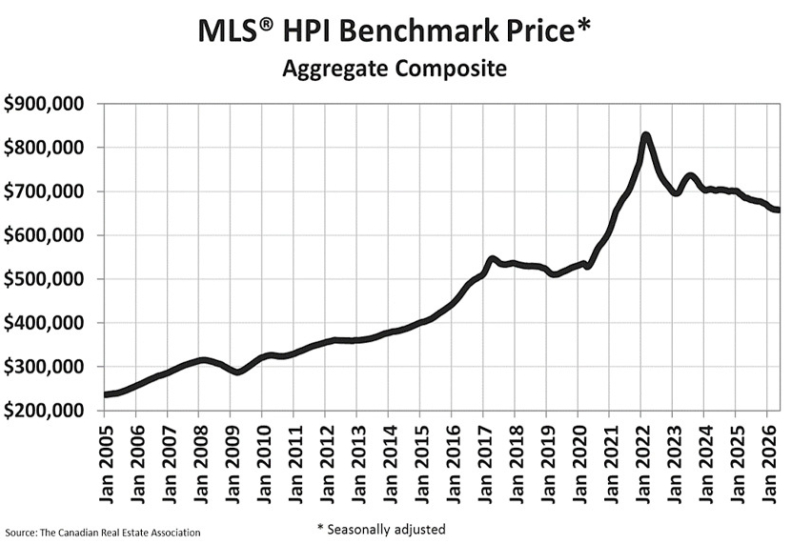
- The MLS® Home Price Index (HPI) inched down by 0.1% month-over-month and was down 4.1% on a year-over-year basis.
- The actual (not seasonally adjusted) national average sale price was up 1.5% on a year-over-year basis in May 2026.
Analysis of May housing market data
New listings fell back by 1% on a month-over-month basis in May 2026. Combined with the jump in sales in May, the national sales-to-new listings ratio tightened to 49.2% compared to 46.2% in April. The long-term average for the national sales-to-new listings ratio is 54.8%, with readings roughly between 45% and 65% generally consistent with balanced housing market conditions.
“Like the weather in many parts of Canada this year, the spring market appears to have been delayed by a month or so, but the May numbers left little doubt that activity is now picking up,” said Garry Bhaura, CREA Chair. “The handoff from May into June is typically the busiest time of the year, so we now have a strengthening market happening at the most active time of the year. If you have been on the fence this year as either a buyer or as a seller waiting for a sign, this could be it, and the first step in coming off the sidelines is to get in touch with a REALTOR® in your area.”
There were just over 200,000 properties listed for sale on all Canadian MLS® Systems at the end of May 2026 on a non-seasonally adjusted basis, unchanged from a year earlier and 2.8% below the long-term average for that time of the year.
There were 4.8 months of inventory on a national basis at the end of May 2026, down from 5.1 months in February, March, and April. This remains very close to the long-term average for the measure of five months. Based on one standard deviation above and below that long-term average, a seller’s market would be below 3.6 months, and a buyer’s market would be above 6.4 months.
Like the weather in many parts of Canada this year, the spring market appears to have been delayed by a month or so, but the May numbers left little doubt that activity is now picking up.”
Garry Bhaura, CREA Chair
The National Composite MLS® Home Price Index (HPI) edged down 0.1% on a month-over-month basis in May. Aside from April, this was the smallest decline since January 2025. This trend of prices stabilizing aligns with sale-to-list price ratios that have been tightening up and days on market that have been edging lower in recent months. Price stabilization has long been an important milestone necessary for buyers to eventually start re-entering the market in larger numbers.
The non-seasonally adjusted National Composite MLS® HPI was down 4.1% compared to May 2025, recording the smallest year-over-year decline so far in 2026.
Regionally, prices remain down on a year-over-year basis in British Columbia, Alberta, and Ontario, offsetting gains in other provinces.
The non-seasonally adjusted national home price was $702,079 in May 2026, up 1.5% from the same month last year. It was the highest monthly national average home price in two years and the first time the measure has tipped above the $700,000 mark in 23 months.
The Bank of Canada and Canadian economy
Meanwhile, the Bank of Canada held its overnight lending rate steady at 2.25% for the fifth consecutive time in a decision widely expected by analysts. In an announcement on June 10, 2026, the Bank immediately keyed on the lengthening duration of the conflict in the Middle East, which is causing high energy prices and rising inflation, also mentioning the ongoing uncertainty from U.S. trade policy.
Canada’s economic performance in the first quarter was weaker than expected, and the Bank noted that domestic financial conditions had loosened since issuing its Monetary Policy Report in April.
Employment strengthened in May, but looking through what’s often volatile labour data, the Bank views the labour market as largely unchanged since the beginning of the year.
Consumer Price Index (CPI) inflation rose to 2.8% in April largely due to higher energy prices. That said, the Bank made clear “there has been limited evidence of broad-based pass-through of higher energy prices to other consumer prices.” The Bank expects inflation to remain around 3% in the near term and seems willing to allow that provided inflation does not begin to creep beyond energy and become persistent.
In his statement, Governor Tiff Macklem reiterated that “economic weakness combined with rising inflation is a dilemma for monetary policy. Raising rates to dampen inflation could further slow the economy. Easing rates to support growth increases the risk that higher inflation becomes persistent. For now, holding the policy rate unchanged balances those risks.”
Importantly, the Bank’s Governing Council stated they would continue to “look through the war’s near-term impact on headline inflation but will not let higher energy prices become persistent inflation.”
With the conflict in the Middle East now in its fourth month after rounds of fruitless negotiation and renewed hostilities, consistently higher energy prices will eventually lead to entrenched inflation. Near the conclusion of his press conference, Governor Macklem stated if this scenario were to play out then “monetary policy will have more work to do—there may be a need for consecutive increases in the policy rate.”
The Bank of Canada will make its next scheduled interest rate announcement on July 15, 2026. The Bank’s next Monetary Policy Report will be released at the same time.